Commonwealth Fusion Systems CEO Bob Mumgaard says the global race for energy fusion is intensifying and could have lasting effects on US energy leadership.
During the Cold War, the US and the Soviet Union competed on almost every front, including territory.
The conflict took a turn for the worse in Oct. 4, 1957, when the USSR launched Sputnik, the world’s first artificial satellite, officially ushering in the Space Age. Nearly 70 years later, the US is facing a new technological race over fusion power, and one CEO warns that Washington could be headed for another “Sputnik moment” as China accelerates.
“Fusion is at its best,” Commonwealth Fusion Systems (CFS) CEO Bob Mumgaard told FOX Business. “We have foreign governments investing heavily, and we can start to see what the fusion industry of the future looks like, and it’s going to be an important industry in the world, especially at the intersection of AI.”
“The US government, which has long been a proponent of integration, is not yet prepared to take advantage of this opportunity and lead to a power struggle,” he added.
THIS DEAL IS ABOUT THE ENERGY OF THE FUTURE, AN EXPERT EXPOSES
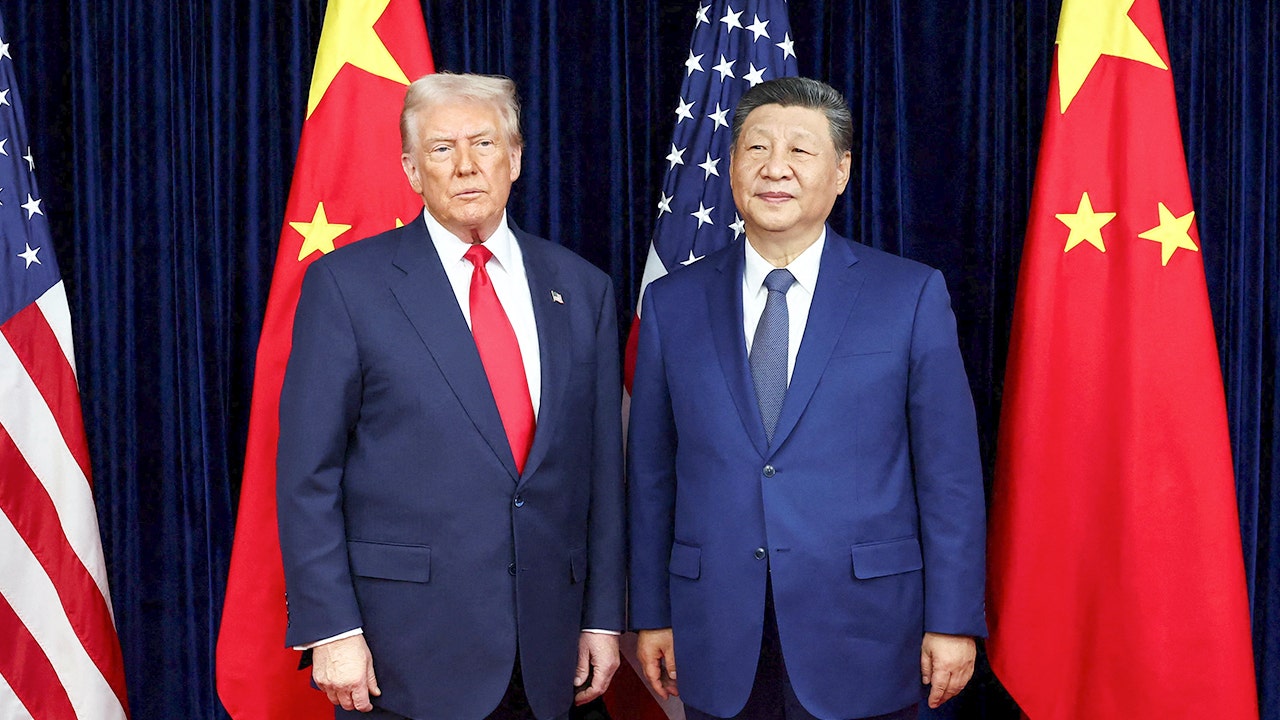
President Donald Trump and Chinese President Xi Jinping stand next to each other, as they hold a bilateral meeting at Gimhae International Airport, on the sidelines of the Asia-Pacific Economic Cooperation (APEC) summit, in Busan, South Korea, on Oct. (Evelyn Hockstein/Reuters/Reuters)
Mumgaard sees China as a major rival to the US as Beijing increases investment and communication about fusion power.
In July, People’s Daily Online, the official newspaper of the Chinese Communist Party (CCP), reported that Beijing had launched China Fusion Energy Co. Ltd (CFEC), a subsidiary of China National Nuclear Corporation (CNNC). The outlet said the company has a registered capital of 15 billion yuan, or about $2.1 billion.
The International Atomic Energy Agency (IAEA) noted in October that fusion power development had “entered a new decisive phase,” underscoring global activity in the industry. The agency cited the work of 33 countries and thousands of engineers and scientists working together to build a tokamak, a donut-shaped magnetic fusion device. The collaboration aims to demonstrate “the feasibility of fusion as a large-scale, carbon-free energy source.”
Mumgaard admits that the potential implications of China winning the fusion energy race are difficult to measure, as the technology is unlike anything that has ever existed.
“We’ve never had a power source like fusion before,” Mumgaard said. He emphasized that fusion, unlike other energy sources, does not require a lot of land or underground infrastructure, which makes it revolutionary.
“It’s hard to know exactly how this will be done, but it’s a big technological change. And China, like all other countries that could have fusion, would like to use it to grow its economy,” said the CEO.
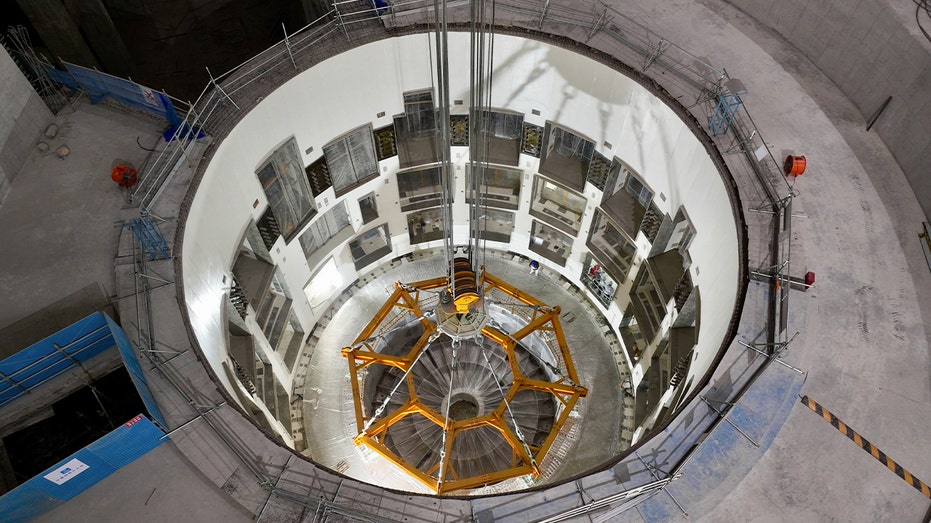
East China’s Anhui province is building a Burning Plasma Experimental Superconducting Tokamak BEST in its capital city of Hefei, which is expected to demonstrate integrated power generation for the first time in history. (Zhou Mu/Xinhua via Getty Images/Getty Images)
TRUMP MEDIA SLAMS HUGE $6B FUSION DEAL TO POWER FUTURE INSTITUTIONS
Mumgaard warned that while China has moved aggressively to advance fusion development, the US infrastructure has not changed.
“You look at China, and the estimates are that China has put $6 billion to $12 billion to work together in the last few years to build large test stands, institutes, organize universities and national labs and private companies to solve the remaining challenges and build electric power plants,” he said. “And the US hasn’t done that yet. We have a fusion system that looks like it was done in the ’90s, so we need to modernize that.”
Mumgaard says that if the US were to modernize its assembly line, it could lead to a revolution in the industry.
In order to speed up America’s space program, Mumgaard suggests that the government look to its previous partnerships with private companies to advance scientific advances, such as working with SpaceX or Operation Warp Speed.
“We think there [are] some of the good models here can be used in the combination of private capital, and now there are more than 10 billion dollars of private companies, but also the creativity and the speed shown by the government,” Mumgaard told FOX Business.
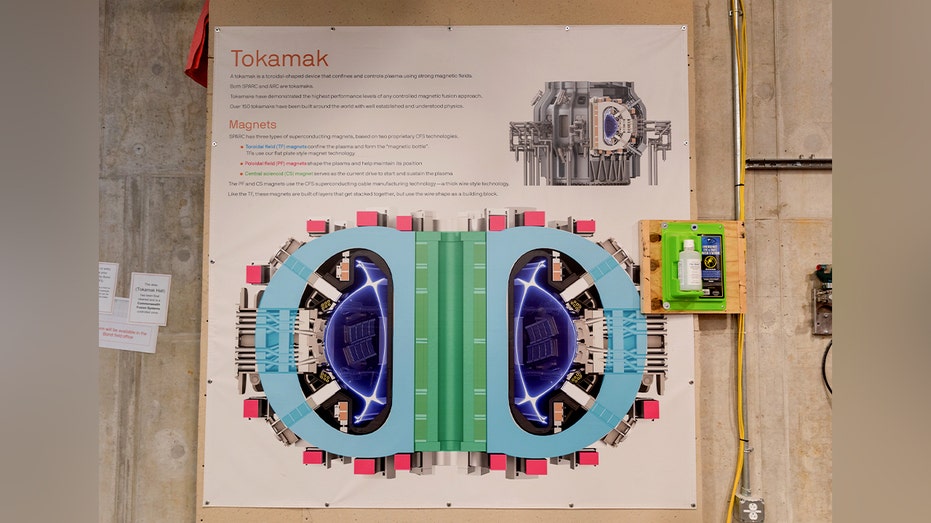
A drawing of the SPRC tokamak at the Commonwealth Fusion Systems campus in Devens, Mass., on Wednesday, Nov. 6, 2024. (Cassandra Klos/Bloomberg via Getty Images/Getty Images)
GROUND BRATION FOR COMMERCIAL-SCALE ADVANCED NUCLEAR REACTOR IN FIRST DECADES IN IDAHO
Despite the warning that America’s integration system remains outdated, Mumgaard said American companies are already working to improve the technology.
Mumgaard spoke to FOX Business from Devens, Mass., where Commonwealth Fusion Systems is building the Soonest Possible Advanced Reactor Compact (SPARC), a device designed to generate more energy than it uses.
Last year, CFS announced plans to independently finance, build, own and operate a grid-scale power plant in Chesterfield County, Va.
“This is a historic moment,” Mumgaard said in a 2024 statement announcing the project. “In the early 2030s, all eyes will be on Richmond County, and especially Chesterfield County, Virginia, as the birthplace of commercial fusion power.”
Mumgaard repeated that early 2030s timeline when he spoke to FOX Business.
For Mumgaard, the clearest sign of whether the US is gaining in the fusion energy race will be tangible results, not just rhetoric.
“The biggest indicator is, ‘do we start building things?'” he said. “‘Do the things we build turn around? Do they work?'”

Bob Mumgaard, founder and CEO of Commonwealth Fusion Systems, speaks during the CERAWeek conference by S&P Global in Houston, Texas, on Tuesday, March 11, 2025. (F. Carter Smith/Bloomberg via Getty Images/Getty Images)
GET FOX BUSINESS ON THE GO BY CLICKING HERE
Transformative technologies like fusion often seem far off until progress accelerates, says Mumgaard, pushing back against the notion that long development times mean success is far off.
Mumgaard compared the work towards integration to past discussions about AI, noting that after years of talk, ChatGPT has become mainstream.
“Fusion is like one of those where, unless you really pay attention to the development at a detailed level, it seems impossible. And suddenly you feel inevitable. And that change can happen very quickly if you just look smoothly,” he said.