Skipping Meals and Keeping Up: How Howard Students Are Coping With Hunger After SNAP Disruption


It’s been more than a month since the federal government reopened after a weeklong shutdown that threatened to cut off food aid for millions of Americans. Lawmakers announced that the problem had been averted. SNAP benefits, they said, will resume. Normalcy, at least on paper, had returned.
But for many college students, including those at Howard University, the sense of relief did not come fully.
During the shutdown, more than a million college students across the country who rely on the Nutrition Assistance Program faced uncertainty about whether they would be able to buy food. Some have experienced reductions or delays in their benefits. Others were worried that they would lose access altogether. And even after the government reopened, the instability revealed how fragile students’ access to food had become.
As the semester winds down and winter sets in, many students are still facing what can be a difficult season of extended meals, skipping dining halls, and relying on campus pantries to fill the gaps left by inconsistent state support.
In Howard, hunger and abundance coexist.
Do you like NewsOne? Find out more! Join the NewsOne Newsletter
We care about your data. See our privacy policy.
Inside the Blackburn University Center, a central student center on campus, students pass a cafeteria, Chick-fil-A, a popular shopping destination, and several convenience-style markets designed to ensure that no one goes hungry. That is, if they can afford it. When ‘food swipes’ or ‘food dollars’ run out, the options quickly become slimmer.
What happens next often depends on availability rather than access, who you know, what resources you know about, and how comfortable you are to ask for help.
Just off the main entrance sits the HU Nourish Pantry, the university’s only free food option. The pantry provides canned goods, toiletries, and, when available, fresh produce to students who are food insecure. It serves about 400 appointments a month and relies heavily on donations, a model pantry director Eryka Byrd says is increasingly struggling as nutritional benefits change and student demand grows.
“We see a lot of students who are not sure who they will receive support from month to month,” said Byrd. “And when that happens, campus pantries become more than a backup plan.”
The concerns of Howard students reflect a broader national problem. More than 1.1 million college students rely on the National Nutrition Assistance Program, or SNAP, to buy groceries each month, according to the US Department of Agriculture. About one in three US college students experience some level of food insecurity, with rates higher at HBCUs, where students are more likely to come from low-income homes or receive Pell Grants. Many HBCUs already operate with limited resources, leaving students especially vulnerable when organizational benefits are delayed, reduced, or difficult to access.
For Morgan Stephens, journalism major, SNAP was essential to staying fed during the school year. Stephens typically gets $144 a month in benefits. After graduating this fall, she opted out of Howard’s meal plan, which costs more than $1,200 per semester, and instead relied on meal prep and grocery shopping.
Last month, his benefits were cut in half.
“The impact was immediate,” Stephens said. “I’ve been in school most of the time, so I’ve been digging in my pockets or asking my mom, ‘Hey, I’m hungry, can you send me $20 for groceries?'”
Where containers of home-cooked meals once filled her backpack, Stephens now relies on fast food and the occasional dinner invitation from friends. He said McDonald’s has become a necessity instead of a preference.
“It’s cheap,” he said. “Even though I don’t really want to, I know I have to eat.”
 Source: Zoe Cummings / Zoe Cummings
For students like Stephens, losing even a fraction of SNAP benefits means reshaping daily routines about what they eat, how long they stay on campus, and how often they ask for help. But many Howard students never qualify for SNAP. A 2024 report from the US Government Accountability Office found that by 2020, fewer than two in five college students who are food insecure meet SNAP eligibility requirements. Of those who passed, 59 percent reported receiving no benefits.
Those students are the reason the HU Nourish Pantry exists.
Established in 2018, the pantry is open to any actively enrolled Howard student, from first-year undergraduate students to West Campus law students. There are no income requirements or eligibility checks beyond registration.
“That was intentional,” Byrd said. “People come for different reasons. Yes, there is an economic need, but some students have food restrictions, some can’t use their meal plans because of their plans, and some just need flexibility.”
Despite widespread demand, the pantry operates at limited capacity. Appointments are required, shelves are donation-based, and the staff is primarily made up of student workers. When supplies run out, there is little ability to restock beyond what donors provide.
With the semester ending and uncertainty about nutrition assistance continuing, Byrd said the pantry is seeing an increase in demand.
“It’s a funny act,” he said. “We want to offer more appointments and more variety, but we also don’t want students to turn up and find empty shelves.”
Access to food in Howard has also grown more difficult as nearby dining options have disappeared. Several popular restaurants along Georgia Avenue, including Chipotle, Subway, Potbelly, and Negril, have closed in recent months. Outside of campus restaurants, the closest option for fresh, prepared food is Whole Foods Market, which many students say is out of reach on a college budget.
Naisha Fletcher, a Howard student whose family immigrated from Haiti, grew up relying on SNAP. Although he no longer draws directly on his family’s benefits, limited access to food in and around the area made hunger a common occurrence in his college life.
“It doesn’t look like a miracle,” said Fletcher. “Skipping breakfast to do an 8am class, realizing at night that there is only water, or walking through the dining hall knowing you can’t buy anything inside.”
For Fletcher, the recent disruption to SNAP did not create a new problem. They went deeper into it.
Students who struggle with eating disorders say they are often hungry on a regular basis, especially at institutions as demanding as Howard, where the pressure of work leaves little room to slow down. Others described choosing between transportation home and buying lunch. Others include phone bills, textbooks, and groceries. As the semester draws to a close, many say the stress of finals is compounded by the difficulty of finding an uncertain meal.
University pantries like HU Nourish are increasingly moving from supplemental services to lifestyle essentials. But those lifestyles remain fragile. Without consistent donations, institutional funding, or expanded partnerships, the pantry must constantly negotiate how to meet growing needs and unexpected items.
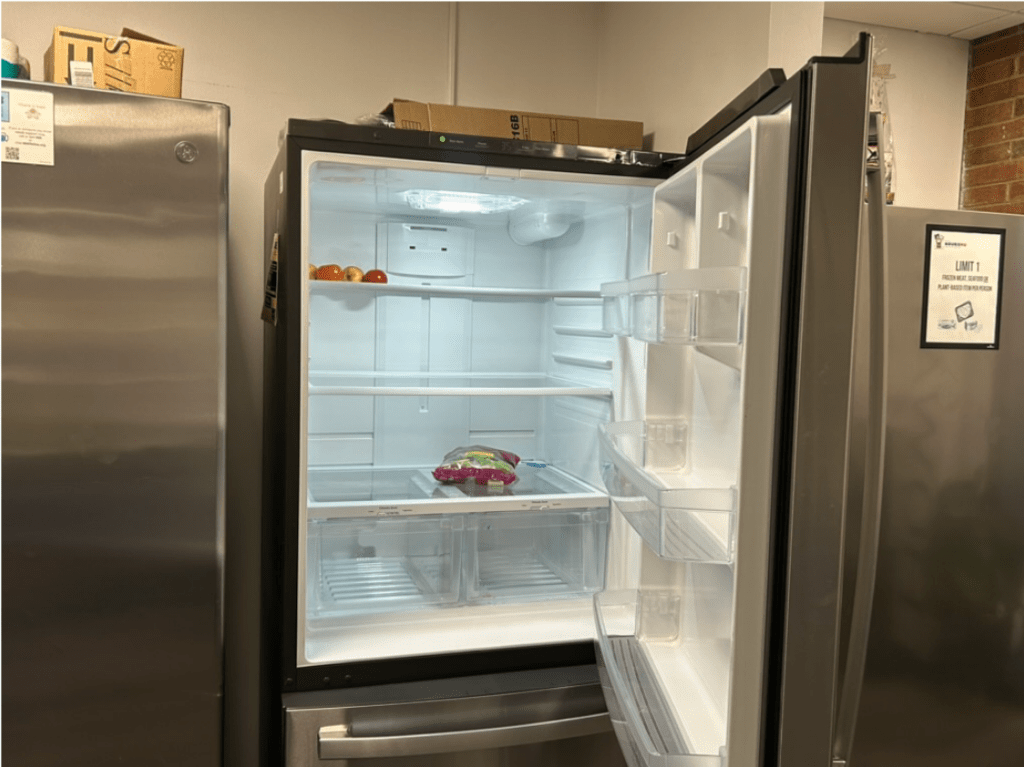
Earlier this week, students entering HU Nourish found the shelves thinner than usual. Canned goods were spaced far apart, and the refrigerator that once held fresh produce contained only a bag of salad greens and one apple.
Byrd said moments like these underscore what’s at stake.
“It is difficult for students to think, work and succeed when they are hungry,” she said. “A well-nourished mind works better. A well-nourished spirit rises better. There are already enough pressures on campus—anxiety about food shouldn’t be one of them.”
Zoe Cummings is a journalism major and Spanish minor at Howard University, covering HBCU issues, politics, and culture. You can follow her on Instagram @zoesxphia.
BREAKFUT:
‘Compassion is Hard to Find in the Big House.’ Howard Student Fears SNAP Cut Before Holidays
I am a Food Stamp Recipient. My Future Depends on Congress